
Net Metering in Florida: How Your Solar Credits Actually Work
The information in this article is intended to be accurate as of November 2026, however net metering terms are set by the Florida Public Service Commission and each utility's tariff, and they can change. It is recommended that you review your utility's current net metering tariff before signing any solar agreement.
With the 30% federal tax credit for homeowner-owned solar officially in the rearview mirror as of the end of 2025, one question has come up in nearly every consultation we've had this year: "Does solar still make sense in Florida without the tax credit?" While every home is different, the answer for most of us here in the Sunshine State is still yes - and net metering is a big reason why.
With no federal incentive to lean on, net metering is now the single most important policy driving the return on a residential solar project. It's also one of the least understood. We regularly meet homeowners who were sold on savings expectations that don't line up with how their utility actually bills them, so let's break it down.
What Is Net Metering?
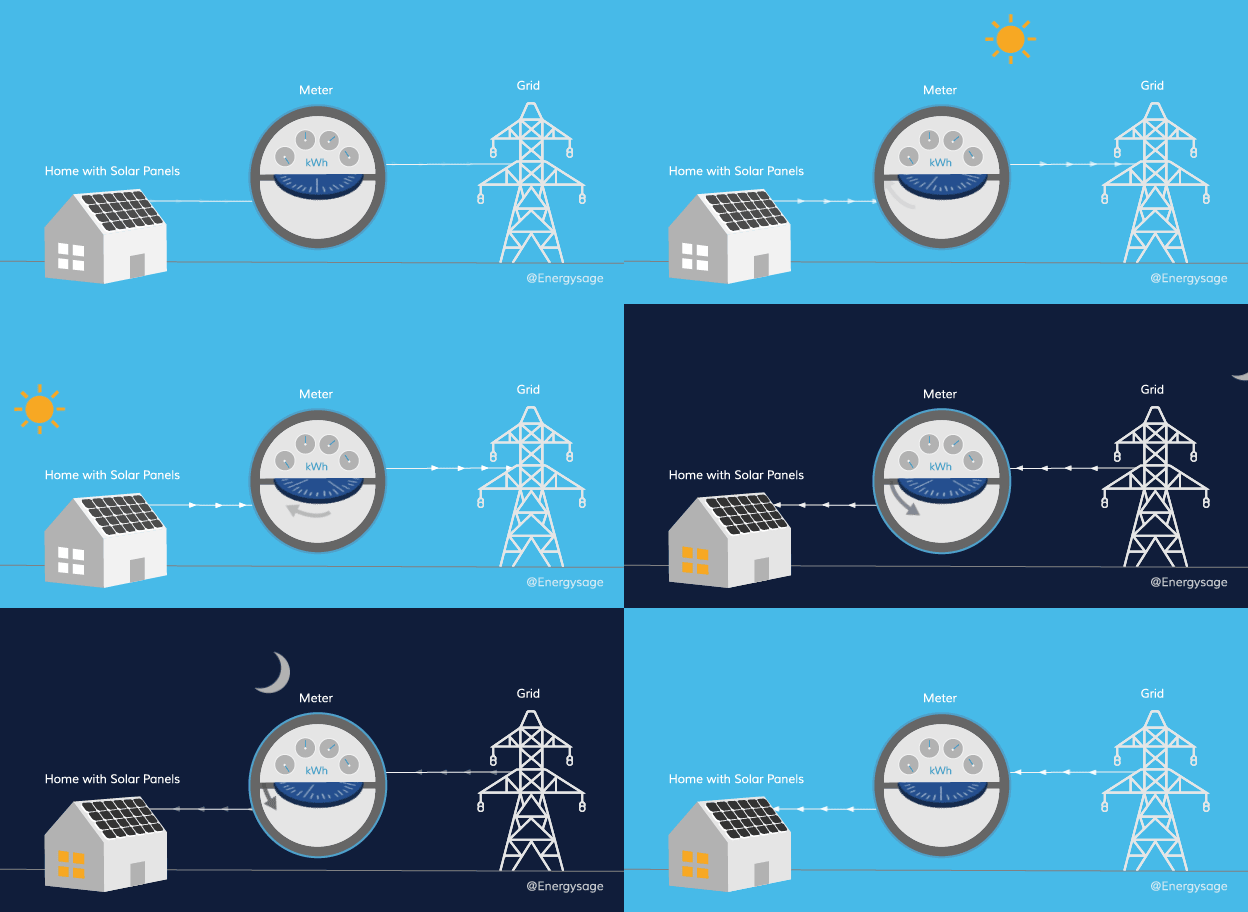
Net metering is the billing arrangement between you and your utility company that gives you credit for the excess energy your solar system sends back to the grid. Solar panels produce the most energy in the middle of the day, which is often more than your home is using at that moment. That surplus flows back out through a bi-directional meter, and your utility credits you for it. In other words, the grid acts as a storage bank for the energy you don't use right away.
In Florida, Rule 25-6.065 of the Florida Administrative Code requires investor-owned utilities - including Duke Energy Florida, Florida Power & Light (FPL), and Tampa Electric (TECO) - to offer net metering for customer-owned renewable systems up to 2 MW. Most importantly, those credits are issued kilowatt-hour for kilowatt-hour at the full retail rate. Every kWh you push to the grid offsets a kWh you would have otherwise bought back at full price.
How the Credits Work: An Example
Let's look at a quick example. Homeowner Maria lives in Brandon and has a solar system on her roof.
In April, Maria's system produces 1,400 kWh and her home uses 1,100 kWh. She has 300 kWh left over, which carries forward as a credit to her next bill.
In July, the summer heat kicks in. Her home uses 1,700 kWh while her system produces 1,350 kWh. Rather than paying for the 350 kWh shortfall, Maria applies her 300 banked kWh first, leaving only 50 kWh to be billed (1,700 used - 1,350 produced - 300 banked).
The math is simple: Net kWh Billed = kWh Used - kWh Produced - kWh Credits Carried Forward. Keep in mind that even in a month where you net out to zero, you'll still see your utility's fixed monthly customer charge and any applicable minimum bill.
The Annual True-Up
This is where many homeowners get caught off guard. Excess credits can roll forward month-to-month for up to 12 months, but at the end of the annual period, any unused credits are paid out at the utility's "avoided cost" rate - essentially what it costs the utility to generate that power themselves. That rate is typically just a few cents per kWh, compared to the roughly 15 cents per kWh Floridians are paying at retail.
The takeaway: bigger isn't always better. A system designed to offset around 100% of your annual usage is generally the sweet spot. If a consultant is recommending a system sized well beyond your usage history, you could end up selling a large chunk of your production back to the utility for pennies on the dollar. It's also worth noting that larger residential systems may cross into Tier 2 (above 10 kW AC), which can bring additional interconnection requirements - we covered that in a previous blog on Florida's insurance requirement for Tier 2 systems.
Is Net Metering Going Away?
It's a fair question, and one we hear often. In 2022, the Florida Legislature passed HB 741, which would have phased down net metering credits for new solar customers. Governor DeSantis vetoed the bill, and as of this writing, no replacement has become law. Full retail net metering remains in place for Florida's investor-owned utilities.
That said, utilities continue to argue that net metering shifts costs onto non-solar customers, and the Public Service Commission has the authority to revisit the rule on its own. Nobody can promise you that today's terms will last forever. What we can tell you is to be skeptical of any company using "net metering ends next month" as a scare tactic to rush you into a contract. If you're served by a municipal utility or electric co-op rather than an investor-owned utility, your net metering terms may differ, so it's important to confirm them directly before moving forward.
The Bottom Line
Net metering is what allows your solar system to work for you around the clock, even when the sun isn't shining. Understanding how your credits are earned, carried forward, and trued-up at the end of the year is the difference between a solar investment that meets expectations and one that falls short.
At Transform Solar, we size every system around your actual usage history and your utility's net metering terms, and we back it with a 1st Year Production Guarantee in our installation contract. If you are looking to evaluate a solar project for your property, please feel welcome to submit a quote request or contact us directly at 813-565-1443.


Comments